Nuking the Fridge: An Opinionated Spielberg Retrospective

As Spielberg’s most famous character is currently being revisited without him, I feel it is time for an opinionated retrospective. The mainstream press holds on Spielberg’s every cinematic word (looking at you, Empire). Everyone sings his praises. Who wouldn’t want to sit and chat movies with Spielberg? Who wouldn’t want to be this guy?

I feel it’s time a sensible voice added something new to the discussion.  

Ah Spielberg, we all know the legend: the shy Jewish kid that went from a product of divorce to the youngest TV director on the lot to the most successful and influential filmmaker of all time. While most mortals can only dream of wealth, fame and success like his, he spent $200 million on a yacht and then had to be talked into going on a cruise in it by his staff.

It’s been nearly 32 years since Indy rode off into the sunset, 30 since Jurassic Park and Schindler’s List. As his remake of Westside Story looms, many might ask has he lost his touch? Of course, he is perfectly entitled to have done so. It is the medium-defining masterpieces of his early career that guarantee his place in the film library on Mount Olympus. Few are lucky enough to have even a lick of that much ‘touch’ or being afforded the opportunity to demonstrate it.

What glorious exercises in cinema those early works are: Duel is a solid exercise in tension. Jaws is so good it hurts. Those barrels bobbing around in the water get me every time. The sublime edit of Raiders of the Lost Ark, with its flawed hero bungling his way through his adventures to the Divine saving the world, is the definition of timeless.

Temple of Doom is highly uneven, the character is more a superhero and loses his charming flaws, yet the filmmaking is awe-inspiring. Witness the colour design, the editing. There are obvious defects in that eras effects but we can forgive that. For anyone who wants confirmation of who really shot Poltergeist, look no further than the tracking shots/close ups used in Doom and how they are replicated exactly in the horror film.

The Last Crusade (if only) is sublime, the only error being the casting of Alison Doody; just cast a German actress! There can’t be a shortage of them. X never marks the spot. With any luck Marcus has the Grail already! Donated by some of the oldest families in Germany! I see you, Tom Stoppard.

Then there were the nineties. Deux Ex Machina entered the room.

I’m going to make a bald claim here – Jurassic Park is not a good film. It is a poor adaption, over-simplifying a great novel and shoe-horning in unnecessary drama with annoying child actors which was soon to be a defining trait (okay, cliché) of his work.  Cliché no. 2 is the Deux Ex Machina ending: they’re doomed… they’re doomed… oh they’re not. Truly a terrible way to write yourself out of a corner.

He pulled the same trick at the end of Saving Private Ryan, yet another massively overrated entry. Witness critics forever shouting about the brilliance of the beach landing sequence, staged straight out of the nightmares of John Ford and Robert Capa. But then what? A cast of faceless no-marks and Tom Hanks. Didn’t that start a worrying trend! For the record, Shakespeare in Love deserved the Oscar. War of the Worlds was ruined by more unnecessary child clichés – the teenage girl with the maturity of an adult, prone to panic attacks whenever the script needed it. The son surviving undercuts the drama in the situation; there are no stakes, Steven!

Then, of course, there is the mighty Schindler’s List. Three hours of near flawless filmmaking ruined in the last five minutes by saccharine schmaltz. “I could have done more” …. Blub blub. Seriously? That’s not how real people act. Schindler watches the workers celebrate the end of the war. Gift of the ring. He walks to his car, gets in. Looks around. Shadow in the car. White headlights, dark screen. Drives off. No words. Fade out. It doesn’t need signposting so explicitly.  Visual poetry ruined by the very emotionalism the film had avoided so well until that point.

Or is it just a well-shot exploitation movie? Jew porn, as the famous playwright noted at the time. Come see the horrors these poor people suffered! It’s shocking! ‘Entertainment’ is one of the first words on the screen. You decide. Terry Gilliam pointed out the film still has a happy Hollywood ending. The Holocaust didn’t for 6 million people.

As for AI, well, that’s a god-awful piece of crap – two thirds a watchable story if we consider it a warning of how creating an immortal robot child would be an act of cruelty. Cut the ending at spending eternity in a glacier and you have a powerful statement. But robot/aliens? And ‘mommy’? Vomit. The publicity at the time made the point Kubrick took years to shoot, whereas Spielberg took mere weeks. Doesn’t it show. You almost have to feel sorry for the marketing people that had to hawk this rubbish.

Minority Report is without doubt the best of his later films. The cinematography is beautiful and the story of an abducted child handled with far more restraint than could be expected. It’s a shame the writers changed the original short story’s ending. The casting of Max von Sydow makes the antagonist obvious from the first scenes.

And then? Some tedium with a horse, some Daniel Day Lewis and some unremarkable historical pieces.  He phoned in Crystal Skull, added CGI monkeys. Ready Player One, whilst technically flawless, is a hollow story of the little people versus the corporation. No hypocrisy here, Mr Spielberg.  

All artists peak, all decline with age, riches and success. But then he made his Tintin movie with visual invention that showed much of the old flare. More of this please.

Let us not forget his involvement in many other cultural crimes: Brett Ratner, JJ Abrams, the John Goodman Flintstones movies and Seaquest DSV to name but a few. Nuking the fridge became Hollywood shorthand for terrible story-telling.

Recently we have had Indy 5’s James Mangold’s Twitter meltdown and The Force is Female. Smart money is on Indy dying on the moon and being lectured for being part of the patriarchy. Spielberg clearly saw what Disney did to Star Wars and stayed clear. You have to respect the man for that and wonder why Mr Ford’s agent would allow him to be part of the trashing of his own legend for a second time.

We have no right to ask the man for anything. He enriched the 70s, defined the 80s and rocked the cinematic world in the 90s. But who wouldn’t want one more fantasy film? One more return to the purity of Raiders of the Lost Ark and Poltergeist?

Can you do it, Mr Spielberg? I’m not ashamed to beg. We’d willing forgive the Deux Ex Machina, the awful child drama, the CGI monkeys and War Horse for just one more piece of cinema to that old standard.

 I constantly get told that its prohibitively hard to get a job in cinema – that the young should chose careers that are ‘useful’ for society, meaning business studies and computing. Yet, to those that dismiss the creative impulse and the dreamers, I ask What did you do during lockdown? Now tell me the world doesn’t need imaginers and creators of fantasies.    

Come on, Mr Spielberg. Show us how it’s done. The autobiographical movie won’t cut it.

Peckinpah’s Finest: The Argument for The Ballad of Cable Hogue

Don’t make me out no saint, but don’t put me down too deep.

The what of the who? Right? I’m trusting you’ve never heard of this movie and I’m going to tell you why it’s worth your time.

The Ballad of Cable Hogue is a comedy western, and to the surprise of many, the film Sam Peckinpah chose to follow The Wild Bunch with. Got your attention now? I hope so.

The Wild Bunch blew many a bloody squib through the Hays code in 1969. Bloody Sam’s tropes are all present in that one – friends betraying friends; men without honour believing they live by a code and contradicting it at every turn. Bloody death, hail of bullets. The eulogy of the western. It appeared the same year as Butch Cassidy and the Sundance Kid (Peckinpah-lite) and a year after Once Upon a Time in the West (1968). Clearly the end was nigh for that genre. The violence of The Wild Bunch sickened many.

Yet, there is much that is remarkable about The Wild Bunch, not least of which being the fact that Peckinpah followed it with a comedy that stands the test of time far better than the rest of his films.

Ride the High Country, The Wild Bunch, Pat Garret and Billy the Kid and Bring Me the Head of Alfredo Garcia are the same film – friends betraying friends and all have not aged well. They feel like genre works of their respective decades. That’s not to say they are not great films; they all stand amongst the true greats of the genre.

But Cable Hogue? Why such obscurity? Why such latent greatness? Considered a minor entry in Sam’s filmography by many, why should its place in the lexicon be rethought?

The film opens with Hogue betrayed by his prospecting partners and left to die in the desert. He finds a water hole and lays claim to it. His ambition being to turn a profit from passing coach traffic. David Warner plays a wayward clergyman (his form of faith-healing involves putting his hands on women’s breasts). Hogue prospers, falls for Stella Stevens and then alienates her; he has his revenge and then, well, someone invents the motorcar. I won’t spoil the ending. It’s another sad story of the passing of the wild west.

Let’s be clear, the heart of this film is Robards. His charisma carries the film with ease. There is subtlety here – compare his Hogue to his Cheyenne in Once Upon a Time in the West. In contrast to that character, Hogue isn’t a superman of the frontier, he is one of the little people, beaten, cynical and world-weary. You feel the emotional pain and fatalism in how Robards carries himself. The world has not been kind to him. When he says he hates to go in amongst ’em, you feel every ounce of his disdain for the company of his fellow men. Unlike the members of the Wild Bunch, you can’t help but feel sympathy for him.

Cable Hogue (Jason Robards) and Hildy (Stella Stevens)

David Warner gives a flawlessly slimy performance – all lust, sweat and appearing permanently in need of a good bath. Warner, never a screen-leading man in his own right, was never better than his roles for Bloody Sam. Compare his role here to Cross of Iron or the predatory man-child of Straw Dogs. Much like Robards, Warner is another who improves films just by being in them.

The snowflakes in today’s audience would no doubt accuse Sam of toxic masculinity – his movies are certainly a man’s world. But, let’s consider Stella Steven’s Hildy: yes, she’s that most tissue-thin of female clichés – the happy hooker with a heart of gold – and spends much of the film in a state of undress. Yet, I ask you this – which of the characters actually ends the film in a better material situation by their own design?

I am unapologetic for my love for this film and I freely admit to being under the spell of the Peckinpah myth. I would rate Straw Dogs as his finest film – certainly the most powerful, but in Hogue we see a movie with a cynical romantic heart and a great character piece that belongs to a different cultural age where the only discussion of intellectual properties was between copyright lawyers. Brands were for cattle.

I’m sure all cineastes go through a Peckinpah period. To fellow fanboys, I recommend David Weddle’s Peckinpah biography If They Move, Kill ’em. As for The Ballad of Cable Hogue, you could do worse than searching it out.

Just don’t turn your back on the people you search with.

Minamata (2020): Review

“Check your settings. You cannot let your emotions run the show… focus on the photograph you want to take. Focus on what you want to say. Do it now.”

W. Eugene smith

Minamata (2020) tells the true story of mercury poisoning in a Japanese fishing community and the celebrated photographer that covered the story for Life magazine.

This is the story of Eugene Smith, a man struggling with his own celebrated history as a documentary war photographer and his obsessive reputation.

The defining image of his Minamata work Tomoko Uemura in Her Bath is regarded by many as his masterpiece – high contrast black and white with a subject that defies words – body horror and parental love expressed with a command of light not seen outside of the Dutch masters.

Tomoko Uemura in Her Bath

In a film with photography at its core, cinematographer Benoît Delhomme deserves much praise for his work here. His colour palette through the film perfectly captures the cold Japanese weather. The temperature is palpable. The camera work is superb – his use of depth of field in several scenes is masterful. Yes, I’m looking at you, Zach Snyder. Smith’s work is restaged flawlessly and integrated into the film’s tone with obvious cinematic skill.

The cast of mostly Japanese actors are magnificent. The makeup and prosthetics are stunning. You haven’t seen a film of this tone done this well since Lynch’s The Elephant Man.   

Several moments stand out – Smith’s interactions with the disabled youth he gives his camera to, the factory manager attempting to bribe Smith and Smith’s advice to Masako Matsumura (Akiko Iwase) as she comes to terms with the horror of the people’s situation. If you need any reminding of how good Depp really is, this is the scene.

The elephant in the room, for some, is the great Mr Depp himself. This film is a statement, deliberately so, as his company produces. You need reminding what made the man an icon? The younger readers, who only know his post-Jack Sparrow pre-Amber Heard period, might beg my forgiveness for ever having doubted his talent. Sure, mega-stardom has meant he has made his fair share of terrible films in the last two decades but then again, who hasn’t fallen into that trap?

In calmer times, this Andrew Levitas’ film would be a worthy contender for Best Picture and Best Actor. It’s quiet release into the world shows just how hard a sell this is in 2021 with both Depp and a white saviour narrative. Anyone triggered by this exercise in humanism is missing something at their core.

Minamata, flowing according to the whims of the giant magnet, is out in the world now.

See more of Smith’s work here, here and here.

On the Chachoengsao – Bangkok Train

Fighting to get a seat means you might not lose face

but you might lose a limb.

Chachoengsao, 2020

The reader should disavow themselves of the widespread delusion that train travel in Asia was ever a romantic experience. Those holding fantastical thoughts of exotic winds, picturesque villages and exotic locals are likely to be disappointed. The wind carries pollen from the fields that causes the worst allergies, the villages are corrugated shanty towns, the locals attired in flipflops and oversize Doraemon t-shirts. The heat squeezes you like having an anvil on your chest.

Central Bangkok is 80 kilometres and two hours away. The calculus of ticket pricing was lost to reason. The cost is a nominal 14 baht – less than 20 pence.  

Chachoengsao Station, 2020

The heavy industrial train that juggernauts itself towards the platform is the locomotive equivalent of a tramp-steamer, propelled mostly by its own weight and good will. The light around its utilitarian bulk bends as it approaches; the time dilation caused by such a mass explains why they never run to time. The schedules are just probabilistic approximations as operators never agree on the correct time.

Getting on is life-threatening – the waiting ticketholders rush the doors the second the train stopped; having to stand is clearly the worst of all possible outcomes. Fighting to get a seat means you might not lose face but you might lose a limb. The appendages lost in the struggle matter little.

Hua Lamphong, Bangkok 2020

Standing on the journey exposes the passenger to all sorts of additional risk. There’s little respect for individual space; hawkers, carrying calve muscle-threatening sharp-edged buckets of iced-drinks, rice meals and unshelled eggs, jostle their way through the carriages, unperturbed by the density of standing passengers.

These fierce and determined saleswomen could teach aggressive sales techniques to stock market traders. Many of the locals travel with bulky goods that block the walkways and exits too. There seems an unspoken arms race in carrying the most absurdly bulky items. Personal space is just a gap to stock more goods in.     

Guard, Chachoengsao Station 2020

The ticket inspectors, attired in fitted military-style uniforms, pass amongst the passengers clicking their punches to signal their approach. It is vitally important to collect those small fees.

Thais sleep in every seat. No-one ever seems to miss their stop.

Chachoengsao – Bangkok Train 2020

The train passes through endless fields of rice, banana and abandoned buildings. Labourers plough paddies in the heat. The local platforms vary, some are decoratively painted in bright colours, most are just bare concrete sited as the only obvious marker of a named destination amongst the anonymous fields. So many passengers get off in the most isolated of spots, the only conclusion is they must enjoy long walks.

Eventually, the fields end, the train passes container yards and multi-lane highways. Planes pass closely overhead. Shanty residencies press tightly to the sides of the trains. Strategically placed furniture, often inhabited, identifies safe spaces between the tracks. 

Hua Lamphong Station, Bangkok 2020

From the glass-less windows you see children swimming in highly polluted dykes, old people dozing in the heat and pre-slaughter wicker-caged ‘free-range’ poultry. Mounds of abandoned TVs and broken spirit houses dominate the industrial kipple littered liberally everywhere. Not soiling the environment you live in clearly isn’t a widely shared notion here.  

The one sadness of the journey is where it ends – Hua Lamphong Station in Bangkok, which is now an aging relic of an Asia passing into memory. It is soon to be replaced by a contemporary one. It screams ‘old world’ at the visitor. The horror of modernisation looms.

Hua Lamphong Station, Bangkok 2020

To call Hua Lamphong beautiful would perhaps be to abuse the adjective. It isn’t pleasing to look out – it certainly isn’t one to experience under duress. But as somewhere to soak up some old world chaos, to see decaying old engines, the surreal ephemera that people travel with and the colourful sights of Thais working and travelling, there is nowhere else like it. Stations aren’t just waypoints, here they seem to be temporary homes too – there are no highspeed links and urgency is an alien concept. Communities grow whilst people wait.

Is this a journey that can be enjoyed? Ultimately not, in most circumstances it is hot, crowded and so so tedious. It really is the least glamorous way to get anywhere. The locals know the train system is a joke and it’s taken as a necessity, not a luxury.

Other than the modest existential benefits of experiencing new sights, this is one to live without. Get the sleeper train to Chiang Mai instead.

Hua Lamphong Station, Bangkok 2020

Reflections on Three Years in Myanmar

The recent military coup in Myanmar might seem of little importance to many of us – just political trouble in a country most could not find on a map, even if they cared to look.

Not only did I find it, I spent three years living in Naypyidaw, the capital.    

The Return of Democracy

Democracy returned to Myanmar on 8th November 2015 – my 39th birthday.

Daw Aung San Suu Kyi’s National League for Democracy won with a landslide. The military kept control of key ministries.

Foreign experts, investors and aid agencies were already flooding into the country. I had arrived six months previously.

I was determined to not spend my free time in my room or in hotel bars bragging about which tax haven I banked in as did most of the NGO staff and consultants. I wanted to see what was going on around me.  

Naypyidaw does not have much to offer; the only other major town in the area is Pyinmana, itself notable only as the halfway point on the crucifying 18-hour train journey between Yangon and Mandalay.

Pyinmana Station, 2016

I was somewhat conspicuous as the only foreigner in that small town – more so with my cameras.  

I heard their language’s equivalent of “My god! Come look what’s coming down the street!” approximately once a visit.

Same World, Different Writer

No other place has affected me as much as the community around Pyinmana’s train station.

I had always wondered if any place remained that was culturally isolated from our own. This illusion was only shattered here by a set of prehistoric parcel scales that had been made in Birmingham. Oh, and me.

The station is nothing special, a hundred metres of concrete with a rusted corrugated roof. The biggest difference to the stations you know is this one is home to a community of families. Each family and their worldly possessions fit in a cardboard box on the platform.  

A Family Living on Pyinmana Station, 2017

One Sunday afternoon, I was blundering around there, ineptly taking pictures. The residents were used to me – they knew I was not a military spy.

A lady asked if I would photograph her teenage daughter. I waited as the girl, excited beyond compare, ran off to beautify herself as best she could. Imagine never having seen your own picture.

Having no way of sharing the images digitally, I made prints and took them back to the family. The shock and gratitude on their faces! Life clearly had not and would not give them much, I hope I managed to make that poor child feel good about herself, if only for a second. 

Of course, I had to take more pictures and this started a cycle as more kids arrived to be photographed. My street photographer’s anonymity was gone forever.

Local Children from the Community Around Pyinmana Station, 2017

Sometime later, I went down to the station early one morning whilst it was still dark. The residents were all huddled together in sleep on their platform. Many waiting for trains were awake and chatting. One party even offered to share their rice with me – they had next to nothing and would have freely given half of it to a complete stranger in the early hours.  

Early One Morning, 2017

Opposing the Junta

If you have ever looked at a map of faraway places and wondered who lives there, imagine how much worse it is knowing who does and that they are once more helpless victims of a merciless criminal junta.

Prior to the coup, the community was threatened as there were plans to replace the country’s narrow gauge railways with something more modern. Whilst I suspect the station is safe from any redevelopment plans now as the international backers are likely to withdrawn from the project, the fate of the good people remains just as tenuous and uncertain.

Myanmar people are tough – I’m sure if you can raise a family out of a cardboard box, you can weather the junta. These people, like the country itself, deserve so much better.

The Express, 2017

On Attending a Stranger’s Funeral in Thailand

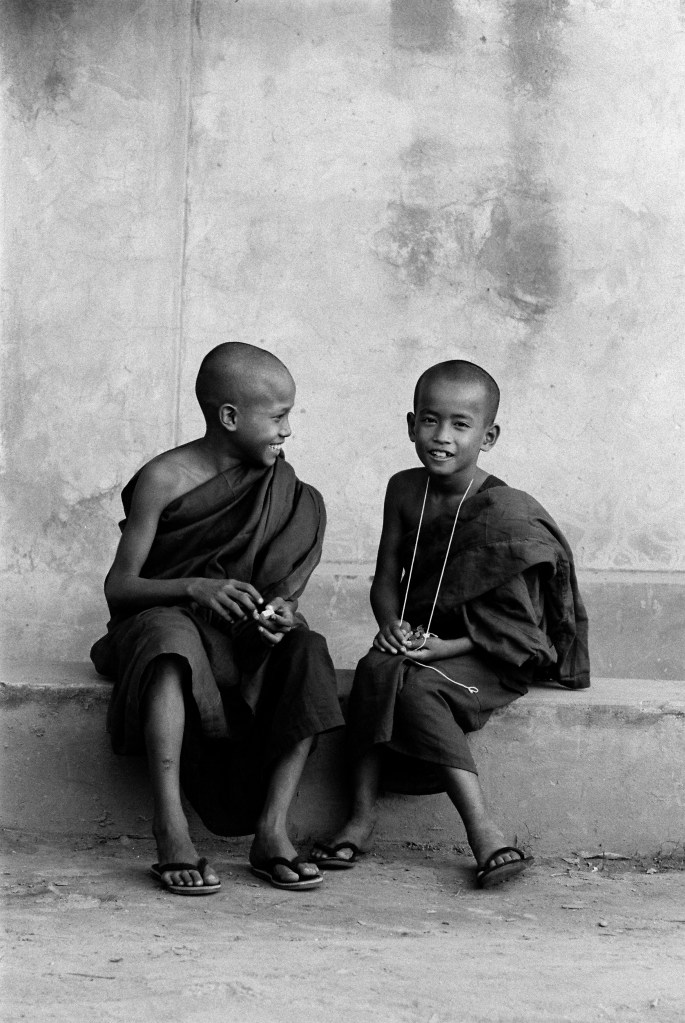
Thai monks always remind me of Discworld wizards, vaguely comical, and either morbidly obese or so body-horror sinewy you wonder whether their organs are still on the inside.

“My dear, you have black dress?” My heart sank. Nina’s English can be a little cryptic at times. She couldn’t mean did I have a black dress; was she inquiring whether I was clairvoyant enough to know she needed hers? I really wasn’t in the mood for code-breaking. The night, it seemed, obliged us to attend a stranger’s funeral. I hastily donned black shirt and trouser, tried to inhibit my cynicism and dutifully fought my way out into the oven hot Thai night.  

I was to be the token foreigner at the funeral. There was the predictable laugh and joke at my expense when I got to the COVID-19 checkpoint: the bald farang should put antibac on his head! Boing! Silly comedy noise on the soundtrack. Smile. Pretend to be amused and laugh along. I had to bend down so the lady with the temperature scanner could reach the side of my head. I climbed over the mountain of shoes in the doorway that offended my health and safety spider-sense and went inside.

Buddhist temples at night are the oddest places, cheap red garden chairs abound, structural columns painted a faux gold and plastic Buddhas all illuminated by stark white strip lights. No mood lights, no atmosphere just bold naked white lights. Floral tributes to the deceased stood in front of small shrine behind which were several unboxed Beko refrigerators. Music played via a USB plugged into DVD player plugged into a Heath Robinson assemblage of wooden boards and frayed cables covered in decades of grime and dust. Everything was open to the air and there were as many stray dogs present as mourners.

We waited for some time for an even number of monks to arrive; they sat on a raised dais after performing some half-arsed supplications to a lunchbox-quality Buddha image. Thai monks always remind me of Discworld wizards, vaguely comical, and either morbidly obese or so body-horror sinewy you wonder whether their organs are still on the inside. The most rotund had a fold-back clip holding his robes in place. The windows behind them were covered by a hanging carpet and several pink children’s blankets. The call and response chanting began, which was oddly relaxing apart from the distortion everytime the lead monk rocked too close to the microphone. Everybody made the Wai and got into their spiritual groove.   

The deceased’s family sat on heavy wooden chairs in front of the monks through the first set of chanting. The monks held what looked like ceremonial fly swotters in front of their faces. As the number of voices in the spiritual chorus raised to four, ceremonial offerings were placed in front of the monks and four family members got on their hands and knees in devotion.  In contrast to the Hindu cremation Nina and I had spectated at in Kathmandu, there was no wailing, no gnashing of teeth and no deathly pallid hands sticking out comically from under shrouds. The whole event took at most twenty minutes and was conducted with the sort of stiff upper lip reserve my Englishness approves of. Nina said the ceremony was cut short due to the lateness of the hour.

Feeling that this anti-climax lacked the grandeur an anonymous cancer victim deserved, I stood back while the departing mourners, Nina and her work colleagues, took selfies and group photos. The deceased raised no objection to this accounting of his life totalling only a co-worker’s status update. The futility of life, social media and cancer fully-measured, the living went for KFC. 

May your death go viral.