Did Disney’s wildly expensive failure pave the way for a stronger vision of Dune?
Many Marvellous Misfires
What do The Marvels (2023), Indiana Jones and the Dial of Destiny (2023), and Cinderella (2025) have in common? Three films. Three franchises. Three expensive Disney flops. Such financial disasters are sadly nothing new to Disney. In 2012, John Carter set a record loss of at least $200 million. Edgar Rice Burroughs’ books are genre-defining fantasies, so how could a movie version of A Princess of Mars fail so spectacularly?
Fantasy Cinema Started Here
Burroughs’ John Carter books are the ancestor of every big screen fantasy you know. Avatar, Dune, and Star Wars all owe their lunch to Burroughs. Yet, Andrew Stanton’s film is a case of ‘all the mistakes everywhere at once’. While this isn’ta ‘the book is better’ argument, the contention is the books are so serial, and so well-planned, they could (almost) be filmed as written. The production was let down by cliched screenwriting that kicked the load-bearing elements out from under it. And hampered it further with poor casting and design choices.
The Film Begins Four Times
The film starts on the wrong note – it shows us Mars is red, then gives us a blue sky. Then, we get an exposition dump about cities on legs – taken straight out of Mortal Engines – that’s never mentioned again. Bad movies start with an explainer.
Burroughs’ Martians fought over dwindling resources on a dying world – clear Malthusian motivation. His cities tended to stay where he left them. The movie gives us godlike beings bestowing magical weapons to one faction in a war. Why? No one ever explains. Thank the screenwriters for this rubbish.
Our Hero
We first encounter John Carter (Taylor Kitsch) as he evades pursuers in late 19th century New York. Then he dies. His heir – Edgar Rice Burroughs – reads Carter’s diary. That starts the story for a third time. While this is taken from the book – where it doesn’t work all that well – it takes up too much screen time. This John Carter brawls a lot, reflecting a little of the character the real Burroughs gave us.
Finally, we get the actual beginning – a chase where Carter and his cavalry pursuers come face-to-face with some Apache. The soldiers shoot first.
Burroughs had Carter fleeing from Indians after he tried to rescue his prospecting partner. He gives a clear ‘leave no man behind’ characterisation and an action-packed start. Putting your lead in immediate danger makes the audience care – even before we know them. Isn’t this taught at film school?
Why do screenwriters assume they know better than the original author? Why this need to interpret and improve tried and tested material? What are the odds against improving a classic? Burroughs’ Carter loved a good fight and was motivated by derring-do. Why explain movie Carter’s reluctance to fight by adding a clichéd backstory – a dead wife and child. Did it need PTSD? Anyone remember Raiders of the Lost Ark working because of the lack of narrative baggage?
Sci-Fi’s First Female Icon
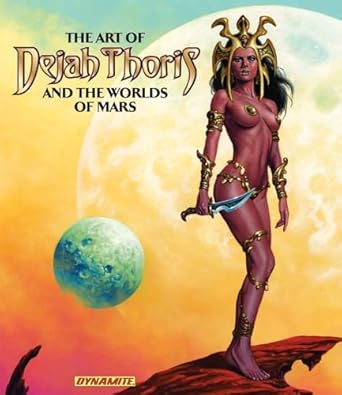
In Dejah Thoris, Burroughs created sci-fi’s original dusky maiden – and a MacGuffin to be coveted and pursued. The movie mistakenly turns her into a warrior and a scientist. Oh, and she found time to discover perpetual motion. How is turning an icon into a by-the-numbers Disney princess an improvement on Burroughs? You embrace icons. You don’t change them.
Dejah Thoris is sci-fi Helen of Troy. She’s no passive victim – Burroughs stresses her pride and defiance – quite a thing when she’s more flesh than fleshed-out. Yet, she’s endured for reasons beyond her minimal attire. That combination — bold beauty and unflinching toughness — is femininity as power. To do her justice, you need to put her onscreen in a way that blows the viewer’s mind. Why is everyone on Barsoom obsessed with her?
It takes quite a talent to capture an icon. Lynn Collins isn’t it. Her Dejah Thoris is generic empowerment pasted over poor casting and puritanical costume designs. She has no chemistry with her leading man, or the audience. This is the ‘no one will steal our cast if we choose people that can barely hit the x on the floor’ TV approach to casting.
Where’s the mythic cinematic presence that means she breaks spirits as well as hearts? If you want to make an icon, you must show us more than a pretty face. Give her charisma, wit, and a design that honours her pulp roots, and you’d have something special.
Who?
Feel sorry for the actor projecting, “I’m Kantos Kan!” Does the audience go, “Look! A character from the book,” or do they simply ask, “who?” Why should the audience care? Screenwriters get this wrong all the time. Name-only characterisation works in novels but not in performance.
Names are empty signifiers. How many times did the Harry Potter writers have someone say “Harry Potter” without ever showing us why we should care about him to begin with? Focusing on named characters without characteristics puts nothing memorable on the screen.
Gods, Monsters and Screenwriters
The Therns – antagonists in books two and three – are sadistic religious fanatics. And that’s removed entirely in the movie, replaced with them being interstellar beings waging unspecified war against one world after another. Why? Who knows? This is Disney hedging. They mustn’t enrage the conservative crowd that was once its core demographic.
These changes weaken the plot too. Burroughs was clever enough to focus it on recognisable people in an alien landscape. Religious fanatics and death cults we can relate to. But godlike creatures of unspecified origins? Lazy deus ex machina clichés. This leads the audience away from Barsoom and leaves story points unresolved. Burroughs focused on Mars and its warlike people. His thoughts on gods are clear enough in book two. How did the screenwriters envision the sequels having just ripped out their spine?
Other essential plot points are included very poorly. Sola secretly being Tars Tarkas’ daughter is lazily done. It’s just blurted out for the sake of ticking a box. No audience sympathy is built for these cyphers. Of course, the makers wasted so much time with the four beginnings, important material like character development was likely cut out. Burroughs’ readers know these characters – the general audience just sees pixels.
Failure By Design
The production and costume design are undercooked too. Everyone onscreen wears ill-fitting wigs and factions are only distinguished by red and blue colour-coding. Burroughs’ characterisations aren’t Shakespeare, but you know who is who. Why can’t the screenwriters create characters deeper than Burroughs’ own “Oh that villainous cad” descriptions? His simple black hat/white hat tropes let the audience know who to cheer for. Onscreen, it’s confusing as everyone looks the same.
As for the world-building, the technology is all high fantasy – isn’t this supposed to be a dying world? Machines need to look cobbled together and mechanical, not shiny new and ethereal. Burroughs describes fleets of flying boats, not clichéd insect-inspired designs made of sunshades. We’ve seen this all before.
Overall, the filmmakers convey a weak reading of Burroughs’ visions. And these are the reasons his work has endured over a turbulent and fantasy-filled century. Who comes to Burroughs for character studies? Concessions to family audiences, sloppy production design and poor characterisation weaken it immeasurably. It’s an epic that isn’t epic, full of sweeping vistas that don’t sweep. Nothing elevates it above the countless Burroughs-derivative visions we’ve seen before. It has no edge and no FOMO.
While not terrible, Stanton’s John Carter isn’t great either. And that makes it the worst anything can be – bland.
From Barsoom to Arrakis
It’s easy to imagine John Carter being an immensely influential film – for all the wrong reasons. Was there a day when Dune’s director Denis Villeneuve and cinematographer Greig Fraser sat and went “We’re not making that!” Dune’s visual style is entirely deducible from what Andrew Stanton and his crew got wrong.
Visual Rhythm
Let’s not proceed by suggesting Dune is without its faults – hello? emotion? Here, we’re discussing design and visual language. Villeneuve’s film is image-led. Every shot directs the audience to a very specific focus. You might not want to visit Arrakis, but it looks amazing. In contrast, John Carter is a world of wonder that isn’t wondrous. It looks like it’s been shot by a soap opera crew and realised with the XP version of Unreal Engine.
Of course, Villeneuve and Fraser had the advantage of large format digital cameras, tools not available to Stanton. But John Carter’s flaws aren’t technological – they’re grounded in a modest visual rhythm and pedestrian shot design. A good director of photography could shoot quality on sticky tape.
John Carter’scamera language is flat. Character moments are shot with the same medium-wide coverage used for establishing shots. The first question asked of any shot – whose point of view is it? – seems to have been ignored entirely. The rare close-up of Carter’s wedding ring draws attention to itself so obviously, Stanton might just have shouted “Important detail!” through a megaphone.
Dune’s visual rhythm – shot selection, depth of field, colour palette – makes good use of every aspect of modern filmmaking. Whether you love or loathe Hans Zimmer’s pots and pans sound design, you must admit it’s at least distinctive. We’re watching a committed mission statement and not, like John Carter, an apology. Likewise, the technology of Dune is satisfyingly industrial and clunky – you come out of the theatre with grease on you. It feels built and has a sense of occupancy. All you get from John Carter is a sense of confusion. Amazon’s Fallout got this right too – kipple everywhere – broken satellites, dust buried cities. Isn’t Barsoom supposed to be a dying civilisation succumbing to entropy? Where is the evidence of its past? How did Stanton get this wrong after getting it pitch perfect in his magnificent WALL-E?
Pitch It: Channel Roger, Frank and Paul
Let’s not suggest John Carter wasn’t made with care – the level of artistry on display in even modest productions puts the rest of us to shame. Both Dune and John Carter had access to the best. Why such a different outcome? Vision. If we are going to revitalise Princess of Mars, we’ve got to go full throttle.
A wishy-washy remake isn’t going to cut it. Let’s take inspiration from the best exploitation filmmakers: Paul Verhoeven and Roger Corman. Verhoeven’s Total Recall points the way – a vision of life on Mars from when movies were made for adults. Corman’s film school graduates made most of the movies we revere today. They knew something we’ve buried beneath test screenings and streaming metrics. If we aim to bring back the audience, we need a production that demands to be seen on something bigger than an iPhone. Two words: controversy and spectacle.
Let’s propose the Rio Carnaval version of Carter, set in the Colosseum: no PG matinees here. Frank Frazetta’s paintings must be at least half of the reason Burroughs’ books endured. You’d be foolish to not put this on the screen. Have Robert Richardson shoot it. Mix in the unsubtlety of Corman’s The Warrior and the Sorceress, Robocop levels of gore, some industrial entropy and the sort of visual rhythm that would make Dune dizzy, and you’d have…something.
Would no respectable actor play Dejah Thoris as written? Fine – cast whoever’s currently trending on OnlyFans. The studios all chase the algorithm, so why not? Subtle? No. FOMO through deliberate controversy? Hell, yes. Movies have always been a vulgar medium. Embrace it. Let’s stop short of Caligula though.
Bring Back Burroughs
Burroughs’ Barsoom stories are riotous fun. Filmmakers like Stanton have been making derivative versions for decades. The time is already here when the studio returns from remakes and rebootquels are running drier than a Barsoomian ocean. The branded franchises of yesteryear are all dead. Are Superman and Avengers: Doomsday going to revitalise cinema? Don’t bet your mortgage on it.
Please, we can’t let Bluey dominate streaming, and Lilo and Stitch be the only film bringing people into theatres. Cinema deserves to bang, not whimper. We’re in dire need of some Hollywood entrepreneurism, if we’re to save the dying world of the movies. More risk-aversion equals more indifferent product and more audience apathy.
Controversy never hurt a film, so why not throw everything there is at Burroughs? If everything has been done, it’s time to do it over again. Better. Let’s go back and do old Edgar proud. Cinema owes him that.
 Lee Russell Wilkes